3D Printing in Circular Interior Design
How Additive Manufacturing Opens New Possibilities
Interior design faces growing demands: individualisation, resource conservation and circularity must not only be considered conceptually, but implemented in practice. At the same time, many established processes still rely on standardised products, fixed geometries and linear material flows. Adaptations are possible, but often come with increased effort.
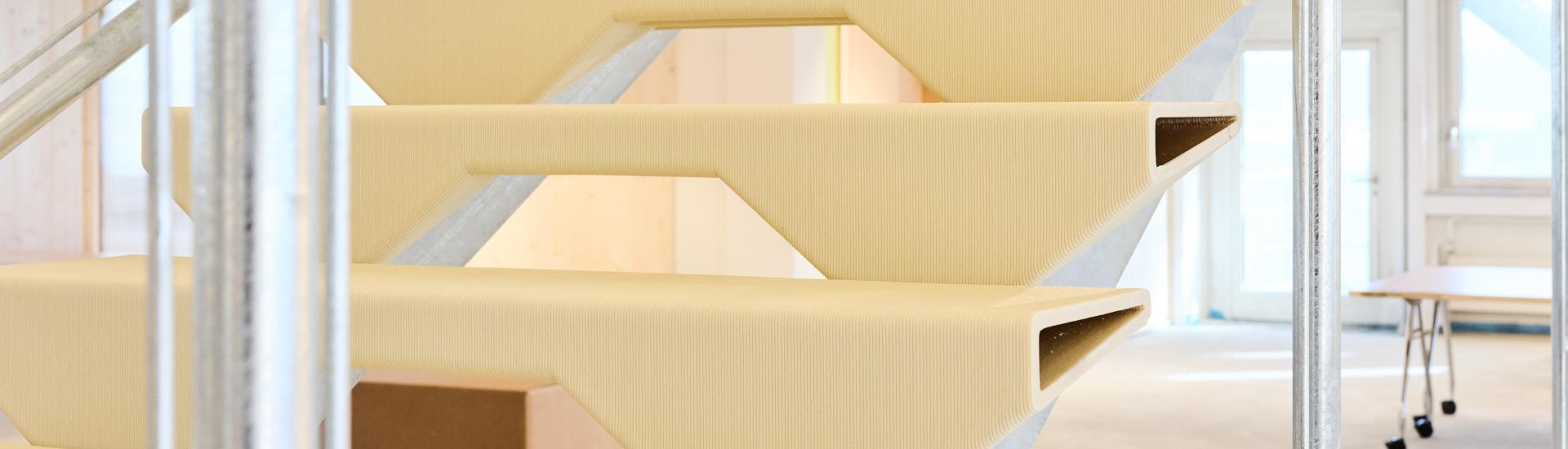
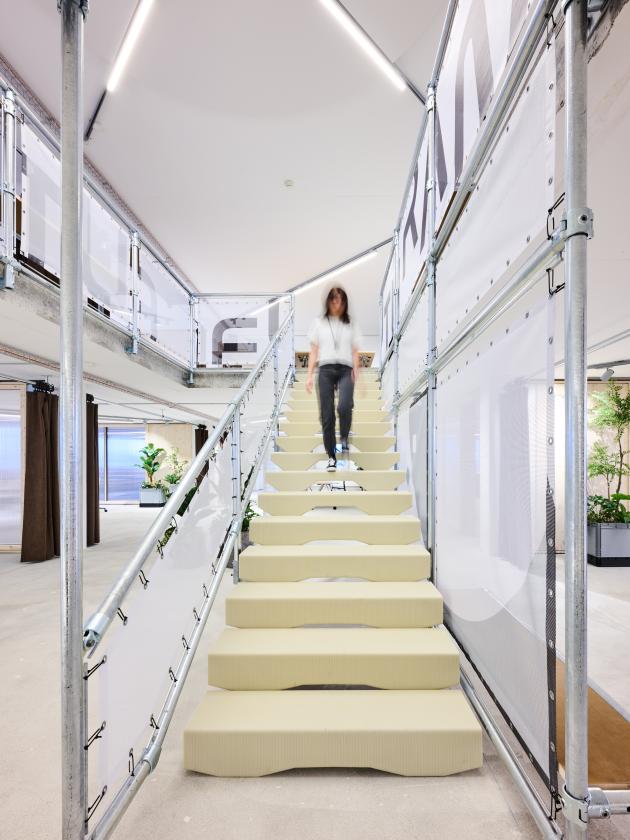
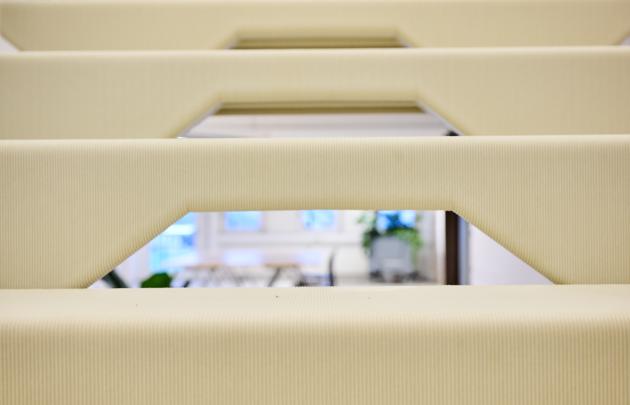
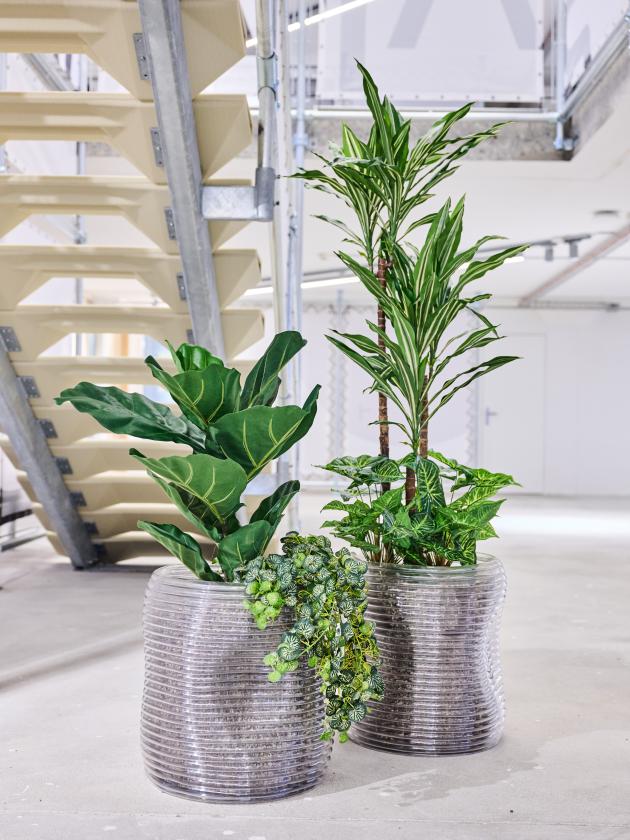
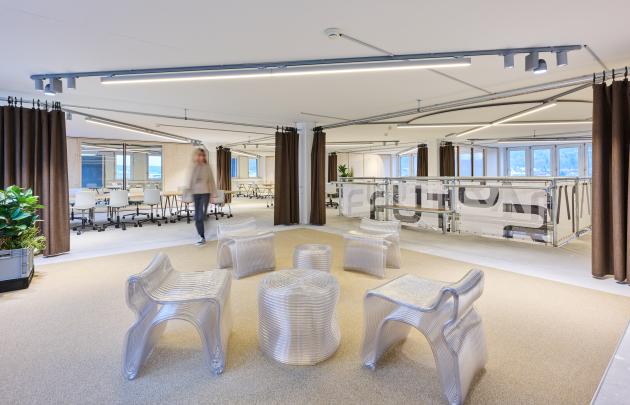
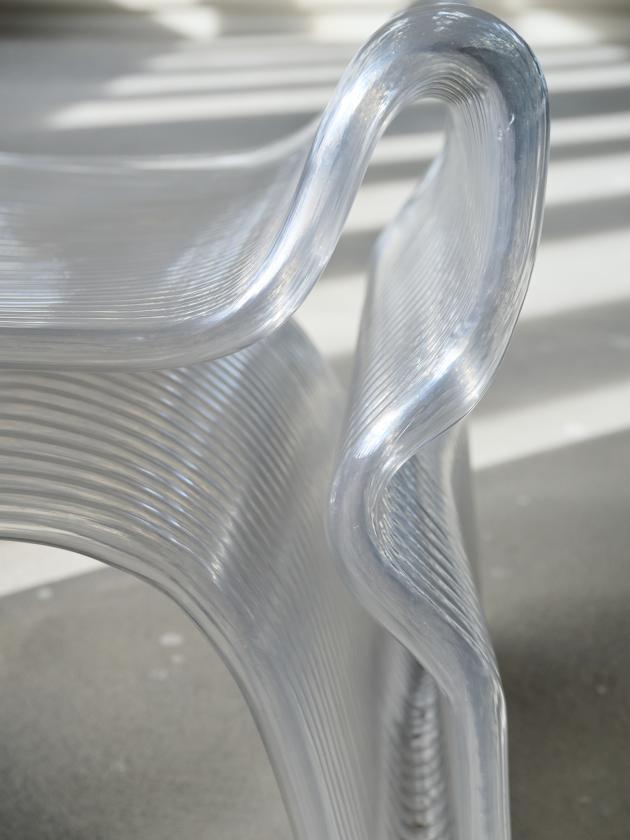
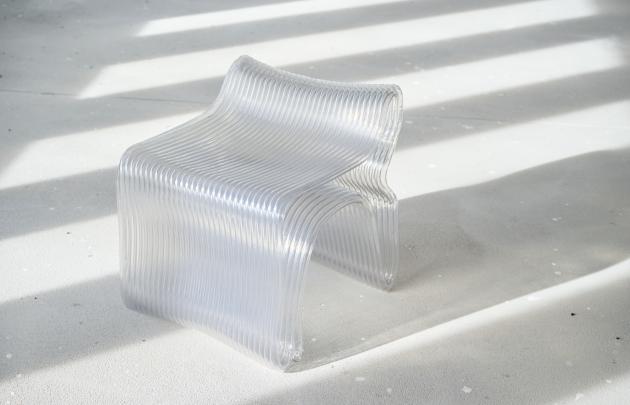
Additive manufacturing offers an alternative approach. Components are no longer cut from standardised panels or profiles, but built up directly in digital form. This allows geometries to be designed more freely, materials to be used more precisely, and functions to be integrated directly into the component. Whether stair treads, furniture, reception elements or planters: 3D printing enables project-specific solutions without necessarily requiring new tools or moulds.
Adaptability as a Systems Principle
The added value lies not only in the individual printed element, but in the underlying principle. Additive manufacturing makes it possible to adapt components within defined technical parameters in terms of geometry, dimensions or structural design. Individualisation can thus be incorporated early in the planning phase, rather than appearing as a cost-intensive special solution at the end of the process.
This approach forms the basis for scalable system solutions. Instead of fixed products, components or modules are created that can be transferred to different buildings, uses and requirements. Changes are not made arbitrarily, but within a clearly defined structural framework.
«3D printing shifts the focus from form-driven one-off production towards systemic thinking, in which material, process and clear parameters take centre stage, and adaptations become an integral part of planning,» explains Remo Hanselmann, Project Lead at Integral design-build.
Material Use and Circularity
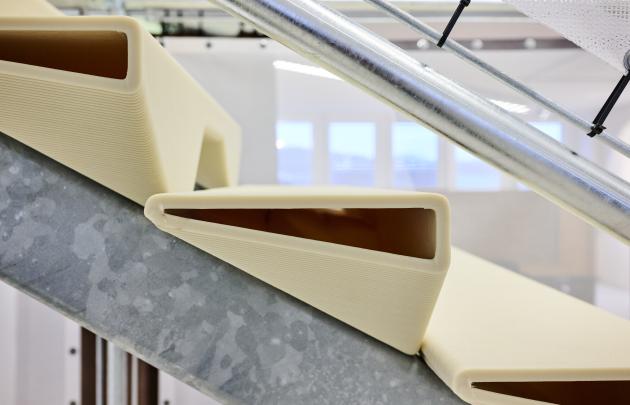
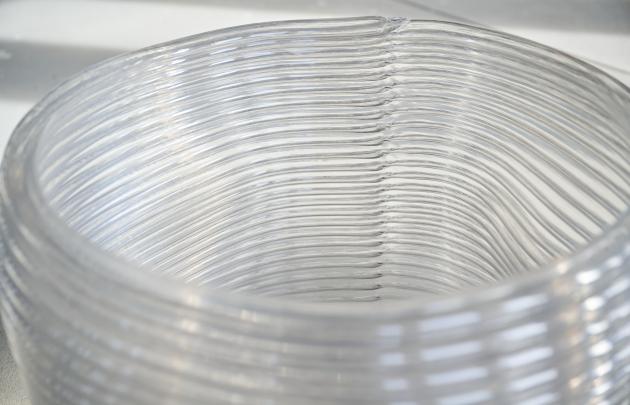
Another relevant aspect is material efficiency. Through targeted design of cavities, wall thicknesses or internal structures, material can be placed where it is structurally required. Plastics that are largely recyclable are among the materials used. Printed components can in principle be disassembled and prepared for reprocessing in the printing process.
At the same time, aspects such as long-term durability, compliance with standards, or the reusability of materials used are still subject to technical review. For a material cycle to work, three conditions must above all be met: materials must be cleanly separated, the melting process must run in a controlled manner, and stabilising additives are used where necessary. Suitable plastics – such as PP or PETG – can in principle be melted down and reprinted multiple times, with material properties declining slightly with each cycle. A completely lossless cycle is not yet achievable today; meaningful multiple use of materials, however, is.
It should also be noted that glass or carbon fibres, frequently used for reinforcement in large-format 3D printing, are shortened during recycling and can impair the mechanical properties of the recovered material. This must be taken into account in material selection and cycle planning. The development of such applications should overall be understood as a step-by-step learning process, in which quality control and the targeted addition of fresh material remain part of a realistic circular concept.
Integrating Planning and Manufacturing Early
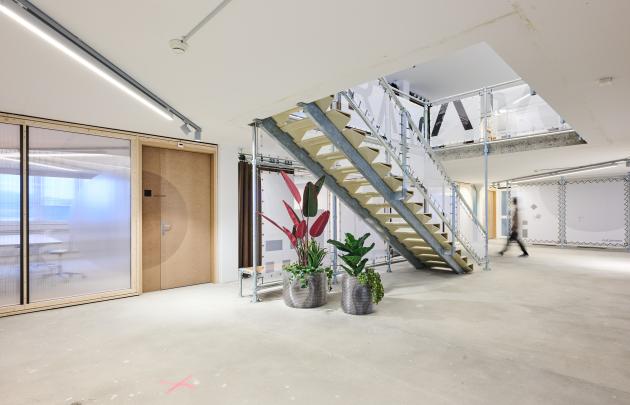
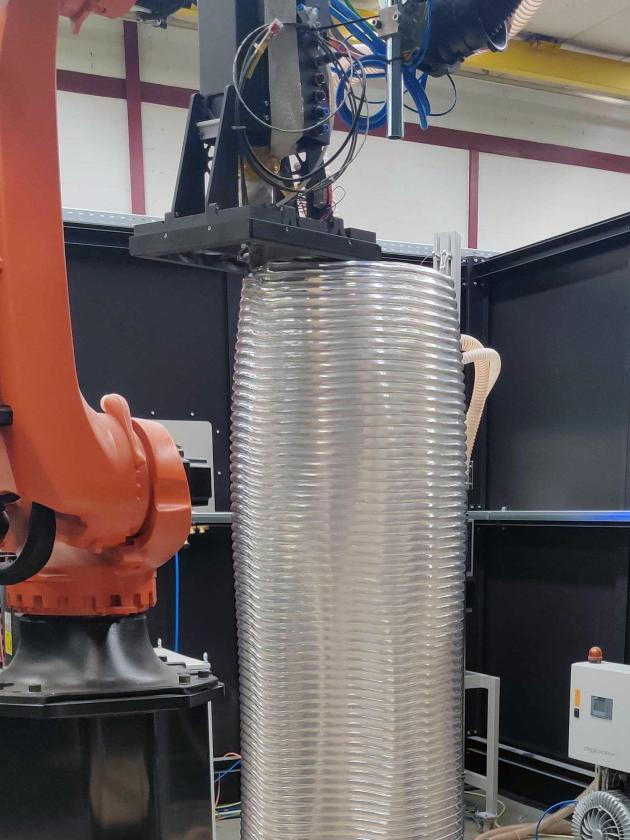
Implementing corresponding projects requires close coordination between planning, construction and production. One example is the Futurama project in Lupfig, where stair treads were realised using large-format 3D printing in the interior fit-out. In collaboration with SAEKI, a company focused on robotic manufacturing in construction practice, the design and production process were coordinated from an early stage and developed iteratively.
Early integration of manufacturing makes it possible to consider technical feasibility, structural requirements and economic framework conditions already in the design phase.
Dr. Matthias Leschok, Co-Founder and COO of SAEKI, puts it succinctly: «Robotic additive manufacturing is not a downstream production step, but a process-defining factor. Geometry, material distribution and printing strategy influence each other. When these parameters are considered during the design phase, the result is robust, material-efficient and economically viable solutions with short production times.»
Leschok also points out that late integration of additive manufacturing into the planning process turns it into a special solution rather than an integral part of the system: geometries that are not print-optimised require subsequent structural adjustments; tolerances and joints are left unconsidered. The potential of the technology is thus only partially realised.
Conclusion
3D printing will not replace conventional interior design solutions. It does, however, expand the range of options where project-specific adaptability, targeted material use and circular considerations are required. The key difference lies not in formal freedom alone, but in the systemic interplay of planning, material and manufacturing.
With technical input from Dr. Matthias Leschok, Co-Founder and COO, SAEKI.